
Project management has long been built around familiar questions: What are we delivering? When will it be delivered? How much will it cost? Who is responsible? How will success be measured?
These questions still matter. However, contemporary projects are increasingly expected to answer a broader and more demanding question:
What kind of impact will this project leave behind?
This is precisely where one of the most important additions introduced through the SPM² approach becomes relevant: the Sustainability Management Plan.
As a new artefact within SPM², the Sustainability Management Plan is not simply another document added to the project file. Its real value lies in the fact that it transforms sustainability from a general intention, strategic aspiration, or declarative commitment into a structured project management practice.
In other words, it helps project teams identify, assess, monitor, escalate, and close sustainability-related issues throughout the project lifecycle.
Why Was a New Artefact Needed?
The PM² methodology already provides a strong and coherent project management structure. It defines lifecycle phases, governance layers, roles and responsibilities, management processes, and key artefacts that support planning, execution, monitoring, control, and closure.
For this reason, SPM² was not developed as a replacement for PM². It was developed as a methodological extension that preserves the strengths of PM² while integrating sustainability more explicitly into project governance and decision-making.
However, when it comes to sustainability, existing project logic is often not enough if sustainability considerations are addressed only in the Business Case, treated as generic risks, or mentioned again at the end of the project. In such cases, sustainability can easily disappear between deadlines, budgets, scope pressures, and day-to-day delivery priorities.
This is why the Sustainability Management Plan was introduced as a dedicated artefact.
Its purpose is not to make projects more bureaucratic. Its purpose is to create clarity.
It defines how sustainability considerations will be managed within the approved project scope. It clarifies who is responsible, when sustainability impacts will be reviewed, how they will be monitored, when escalation is needed, and what happens to sustainability responsibilities after the project is formally closed.
Sustainability Within Governance, Not Next to It
One of the key principles of SPM² is that sustainability should not become a parallel workstream.
If sustainability is managed separately from the existing project governance structure, it risks becoming isolated, informal, or dependent on the enthusiasm of individual team members. In that case, sustainability may be discussed, but it may not influence actual project decisions.
The Sustainability Management Plan addresses this problem by working within the existing SPM² governance arrangements.
It does not create a new hierarchy. It does not replace existing project roles. Instead, it helps distribute sustainability-related responsibilities across the already established roles and governance mechanisms of the project.
This distinction is important.
Sustainability is not “someone else’s additional task”. It becomes part of how the project is planned, reviewed, monitored, escalated, and closed.
In practice, this means that the project can define sustainability control points: moments during the project lifecycle when sustainability impacts are reviewed, actions are checked, responsibilities are confirmed, and escalation decisions are made when necessary.
From Intention to Traceability
One of the greatest challenges in sustainability-oriented project management is traceability.
It is easy to state that a project contributes to sustainability. It is much harder to demonstrate how sustainability impacts were identified, who was responsible for them, which decisions were made, what actions were taken, and how unresolved issues were transferred or closed.
This is why the Sustainability Impact Log is such an important part of the Sustainability Management Plan.
The Log allows the project team to record, describe, assess, and monitor sustainability impacts throughout the project lifecycle. These impacts may relate to environmental, social, governance, or long-term value dimensions.
This is important because sustainability in SPM² is not reduced to environmental protection only. It is understood more broadly, through the project’s effects on people, governance, responsibility, institutional learning, long-term value, and the ability of project results to remain meaningful after delivery.
The Sustainability Impact Log helps the project team answer practical questions such as:
Which sustainability impacts have been identified?
How likely are they to occur?
How significant are they?
Do they require escalation to higher governance layers?
Who is responsible for monitoring them?
Which mitigation or monitoring actions have been defined?
How are they connected to risks, changes, deliverables, or other project documentation?
In this way, the Sustainability Impact Log becomes more than a record. It becomes a governance tool.
It supports transparency, accountability, and evidence-based decision-making.
Sustainability Does Not End at Project Closure
One of the most interesting aspects of the Sustainability Management Plan is that it does not treat project closure as the end of the sustainability story.
In traditional project management, closure is often associated with deliverable acceptance, final reporting, lessons learned, and administrative completion. These elements are essential, but sustainability-integrated projects require an additional perspective.
Some sustainability responsibilities continue after the project team has been dissolved.
For example, a project may introduce a new system, a new process, a new training programme, a new infrastructure component, or a new governance practice. The deliverable may be formally accepted, but the real question remains:
Who will continue to monitor its sustainability effects?
Who owns the long-term benefits?
Who ensures that sustainability commitments are not forgotten after the project closes?
Who takes responsibility for obligations that extend beyond the project lifecycle?
The Sustainability Management Plan introduces this logic directly into the project closure process.
If post-project sustainability responsibilities exist, they must be identified, assigned, and formally transferred before the project is closed.
This may seem like a small methodological detail, but it represents a significant shift in thinking. It prevents sustainability from remaining trapped inside a temporary project structure. Instead, it connects project delivery with operations, organisational ownership, and long-term value creation.
What Does This Artefact Change in Practice?
The main change introduced by the Sustainability Management Plan is not that the project team receives one more template.
The real change is the mindset behind the template.
The artefact reminds the project team that sustainability must be planned, monitored, documented, reviewed, and transferred where necessary.
It reminds the Project Manager that sustainability is not only a strategic context, but also an operational management concern.
It reminds the Project Owner and governance bodies that sustainability expectations must be clear, traceable, and connected to real decisions.
It reminds the organisation that project value is not measured only at the moment of delivery, but also through what remains after closure.
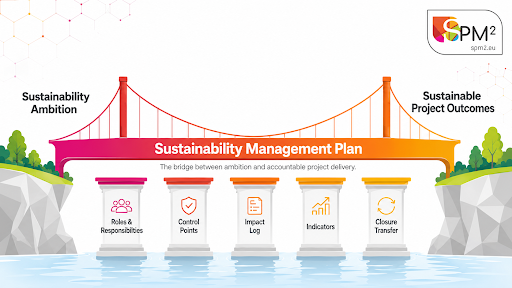
This is why the Sustainability Management Plan has a special place in the SPM² methodology. It shows that sustainability is not simply added to project management as a topic. It is translated into responsibilities, control points, indicators, logs, decisions, and ownership.
A Small Artefact with a Significant Methodological Role
At first glance, the Sustainability Management Plan may look like another planning document. In reality, its role is much more important.
It acts as a bridge between sustainability ambition and project management practice.
Through this artefact, SPM² demonstrates how sustainability can be integrated into the existing PM² logic without disrupting its governance architecture. It does not introduce a parallel system. It does not replace the core PM² structure. Instead, it extends that structure so that it can respond to contemporary expectations related to responsibility, transparency, long-term value, and sustainable project outcomes.
Because sustainability in projects does not begin when we state that it is important.
It begins when we know who is responsible for it, when it will be reviewed, how it will be monitored, when it must be escalated, and who will carry it forward after the project is closed.
Author:

MSc Bojana Savić is a PhD student in Industrial Engineering and Engineering Management. She is currently employed as a teaching assistant at the Faculty of Technical Sciences, University of Novi Sad, where she is actively involved in EU-funded projects.