
The theory surrounding micro-credentials sounds flawless: European standards, instant online verification, and highly motivated students. But how does this mechanism actually perform when deployed in a real academic ecosystem? At the University of Information Technology and Management (WSIiZ) in Rzeszow, we decided to find out. We moved from concept to execution by launching a comprehensive pilot program. Today, we are sharing our data, our successes, and the very real challenges we encountered along the way.
The WSIiZ Pilot by the Numbers: Breaking Down the Data
Our pilot program proved that micro-credentials are not just meant for the IT sector; they can bridge incredibly diverse fields of study. We successfully issued digital badges across various disciplines, including 2D Animation (31 badges), 3D Graphics (25 badges), Functional Cosmetic Emulsions (14 badges), Musculoskeletal Taping (14 badges), and Data Science Project Management.
The overall pilot results revealed encouraging statistics:
- 169 total badge recipients.
- 24 unique types of badges implemented.
- 38 separate badge issuance events conducted.
- 73% badge acceptance rate meaning nearly three-quarters of the recipients actively claimed their digital badges in their Open Badge Passport accounts.
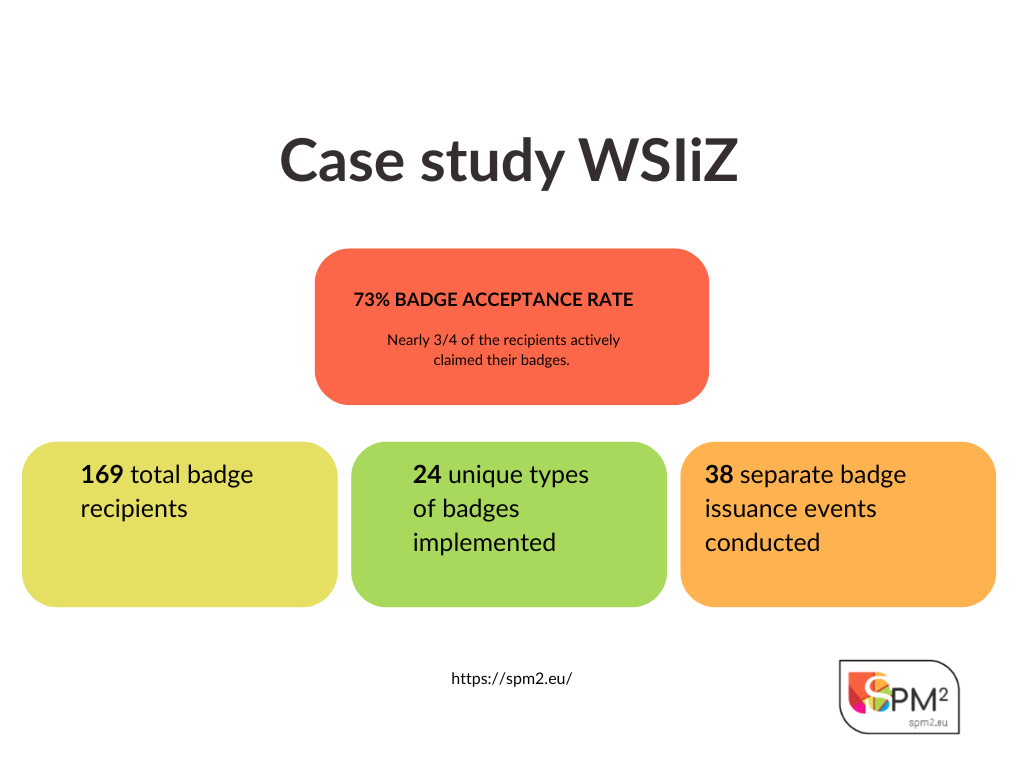
This high acceptance rate shows that students do not just leave their credentials “in a drawer” they recognize their tangible worth for their professional portfolios.
The Core Process: How to Turn a Course into a Badge
To make the pilot sustainable and legally compliant, we established a strict three-step framework governed by university leadership and faculty:
- Registration & Alignment: During the very first class, the lecturer outlines the specific conditions and provides a clear, 1-page breakdown of the skills to be assessed.
- Execution & Rigorous Assessment: Throughout the course, students are evaluated based on transparent, pre-defined criteria rather than simple attendance. Assessments are done under strict supervision, requiring identity verification where necessary.
- Issuance & Sharing: Once the criteria are met, the Center for Didactics Development (CRD) issues the badge via the Open Badge Factory platform, delivering a verified digital record straight to the student’s inbox.
Lessons Learned: The Good, the Bad, and the Complex
The pilot gave us clear evidence of what works. Micro-credentials have significantly enhanced transparency, helping both students and teachers better articulate specific learning outcomes. They have also positioned our university as an innovative, digitally-forward institution.
However, we also faced notable hurdles. The primary challenge remains low public awareness. Some students and employers still confuse micro-credentials with basic certificates of attendance. Furthermore, online visibility is a challenge: while 73% accepted their badges, only about 12% (21 out of 169 recipients) shared them publicly on social media. When they did share them, LinkedIn was the platform of choice by a landslide, accounting for 76% of all shares.
Additionally, national legal frameworks present a roadblock. In Poland, micro-credentials currently operate in a legal “gray zone” lacking a formal state definition, creating administrative questions around external GDPR hosting and ECTS integration.
For WSIiZ, this pilot is not a standalone experiment; it is an active pillar of our long-term institutional strategy. WSIiZ is currently leading micro-credential development across four major international projects.
Most notably, this includes the SPM² project (Sustainable Project Management through PM²). Within SPM², we are leveraging these exact lessons to build modular, stackable credentials that will allow project managers across Europe to seamlessly verify their ESG and sustainability skills in seconds.
What do you think? Would verified, click-to-validate digital badges make the recruitment process easier in your organization?
Authosr:

Dr Joanna Świętoniowska
is Director at the Centre for Didactic Development and an Assistant Professor in the Department of Management at WSIiZ. Her work focuses on project management, innovation, entrepreneurship, and gamification in education. She combines academic research with international project leadership and consulting.

Dr Joanna Wójcik
E-learning expert at the Center for Didactics Development (CRD), University of Information Technology and Management (WSIiZ) in Rzeszow, Poland. In the SPM² project, she focuses on designing digital competence ecosystems and implementing verified micro-credentialing systems.